
 How-to
Do Compression Socks Really Improve Vascular Health?
Last Updated: October 26, 2026
Quick Summary
Compression socks improve vascular health by applying graduated pressure that is tightest at the ankle and looser toward the knee, which helps veins push blood back up toward the heart. This supports venous return and can reduce swelling, aching, and leg heaviness. They manage symptoms but do not cure circulation disorders.
- Graduated pressure is tightest at the ankle and gradually looser up the calf.
- Evidence is strongest for swelling, aching legs, and post-surgical recovery.
- Socks under 20 mmHg are sold over the counter as a mild entry point.
- Put socks on in the morning before swelling builds, and remove them for sleep.
- Skip compression or get clearance first if you have peripheral artery disease.
Table of Contents
- How Compression Socks Improve Vascular Health
- Compression Socks Benefits and Side Effects
- Compression Socks for Leg Swelling
- Choosing Compression Sock Compression Level
- How Long to Wear Compression Socks
- Who Should Avoid Compression Socks
- Getting the Fit Right: A Step-by-Step Routine
- Supporting Circulation From the Inside
- Frequently Asked Questions
How Compression Socks Improve Vascular Health
Compression socks improve vascular health by applying controlled pressure that helps blood move back toward the heart.
Compression socks are elastic garments that squeeze the leg with graduated pressure, tightest at the ankle and looser toward the knee. That pressure gradient helps veins push blood upward against gravity.
The idea sounds almost too simple. But the mechanics hold up, and the limits matter just as much. Below, we'll show you exactly how graduated pressure works, who benefits most, and how to pick a pair that actually fits.
Graduated Pressure and Venous Return
Graduated compression works because the squeeze is not uniform. The sock applies the most pressure at the ankle and gradually less as it climbs the calf, which nudges blood upward through the deep veins.
Your veins rely on one-way valves to keep blood moving toward the heart. When those valves weaken, blood pools in the lower leg. That pooling causes heaviness, swelling, and that end-of-day ache.
Compression therapy counters this by supporting venous return, the flow of blood back up the leg. The pressure gradient gives the veins a gentle external push.
Want the deeper physiology? Our guide on how nitric oxide signals vessels to relax and widen explains the signaling side of blood flow. And for a plain overview, see what healthy circulation looks like and how to support it.
What the Evidence Shows, and What It Does Not
The evidence for compression is strongest for symptom relief, not for preventing disease. Medical guidance generally supports compression for swelling, aching legs, and post-surgical recovery.
What it does not do is replace medical care for a clot or a circulation disorder. If you have a diagnosed condition, compression is a support tool used alongside treatment, not a substitute.
Here's the honest framing: compression socks help manage symptoms and support venous return. They are not a cure, and results vary from person to person. Talk to a healthcare professional before starting, especially if you have any vascular diagnosis.
Compression Socks Benefits and Side Effects
Benefits center on comfort and circulation support, but not all claims are equal.
Established uses. Medical guidance generally supports compression for swelling, aching legs, and post-surgical recovery, and for supporting venous return during long periods of sitting or standing.
Plausible but less certain. Claims that compression socks improve athletic performance, reduce muscle soreness after exercise, or prevent long-term vein disease are supported by weaker or mixed evidence.
What compression does not do. It does not replace medical care for a clot or a circulation disorder, and it does not treat every cause of poor circulation.
Common benefits include:
- Less fluid buildup in the lower legs
- Reduced aching and tiredness
- Support for venous return during long sitting or standing
- A feeling of lighter legs by day's end
How to Tell Whether They Are Helping
Rather than judging by feel alone, track a few concrete indicators over the first couple of weeks:
- Swelling: Compare ankle and calf circumference in the morning and at day's end. Less end-of-day increase is a positive sign.
- Discomfort: Note whether heaviness or aching arrives later in the day or is milder than before.
- Skin changes: Watch for less indentation from sock bands or shoes, and for any new redness, irritation, or marks.
- Fit behavior: A sock that stays in place without pinching or rolling down is working as intended.
If symptoms worsen, if swelling becomes sudden or one-sided, or if you notice pain, warmth, or color change, stop and seek medical evaluation.
Side effects are usually minor. Skin irritation, tightness at the top band, and difficulty putting them on are the most frequent complaints. Rarely, pressure that is too high can cause discomfort or numbness.
Here's the honest framing: compression socks help manage symptoms and support venous return. They are not a cure, and results vary from person to person.
Compression Socks for Leg Swelling
Compression socks reduce leg swelling by pushing excess fluid out of the tissue and back into circulation. Edema, the medical term for that fluid buildup, responds well to gentle, consistent pressure.
Swelling often worsens with prolonged standing, long travel, or heat. A well-fitted sock worn during those times can limit how much fluid collects.
But swelling has many causes, and some are serious. If swelling comes on suddenly in one leg, or comes with pain, warmth, or redness, get medical care right away. That pattern can signal a clot.
For a broader look at the warning signs, read our breakdown of the signs of low nitric oxide levels. And if you want daily habits that help, our step-by-step guide on how to reduce leg swelling naturally pairs well with compression.
Choosing Compression Sock Compression Level
Compression level is measured in millimeters of mercury, written mmHg, and it is the single most important spec to get right. Too little does little; too much can be uncomfortable or unsafe without guidance. In the United States, compression garments are commonly grouped into pressure ranges that map to how they are sold and fitted:
| Pressure range | Typical label | How it is usually sold | Common use |
|---|---|---|---|
| Under 15 mmHg | Mild / everyday | Over the counter | Tired, achy legs; travel; long standing or sitting |
| 15-20 mmHg | Mild-to-moderate | Over the counter | Noticeable end-of-day swelling; prolonged standing |
| 20-30 mmHg | Moderate | Often fitted; some OTC | Clinician-recommended support for mild venous symptoms |
| 30-40 mmHg | Firm | Prescription or professional fitting | Specific medical guidance only |
| 40 mmHg and above | Extra firm | Prescription or professional fitting | Managed care settings |
Those ranges are the practical frame most practitioners use, but the exact numbers a clinician recommends depend on your symptoms, your activity, and any diagnosis. A few rules of thumb help:
- Start mild if you are healthy and just want comfort. Under-20 mmHg socks are widely sold over the counter and are the usual entry point for travel or long workdays.
- Do not self-prescribe 20 mmHg and above. Higher pressures are where fitting, measurement, and a circulation check matter most.
- Match the sock to the job. A knee-high 15-20 mmHg sock for a flight is a different tool than a 30-40 mmHg garment fitted for a diagnosed venous condition.
- Pressure is not the only variable. Length (knee-high vs. thigh-high), fabric, and fit change how a given mmHg rating feels and performs.
If you are unsure, start mild and ask a healthcare professional. Do not self-prescribe a firm level. The next section covers who should get screened before wearing compression at all.
How Long to Wear Compression Socks
Most people wear compression socks during the hours they are upright and active, then remove them for sleep. A common routine is to put them on in the morning before swelling sets in and take them off at night.
How long to wear compression socks depends on why you are wearing them. For travel or long standing, that may mean the duration of the trip or workday. For ongoing swelling, a clinician may suggest daily wear.
Start with a few hours and build up. If they feel right, extend the time. If they irritate your skin or feel too tight, shorten the window and reassess the fit.
Who Should Avoid Compression Socks
Compression socks are not for everyone. The biggest concern is poor arterial circulation, where the arteries that bring blood into the leg are narrowed.
In that situation, extra pressure can reduce blood flow further. That is why a circulation check matters before you start, especially if you have diabetes, peripheral artery disease, or poorly healing wounds.
Skip compression, or get clearance first, if you have:
- Diagnosed peripheral artery disease
- Significant arterial narrowing
- Severe neuropathy with reduced sensation
- Skin infections or open wounds on the leg
This is where a professional screening earns its keep. A simple arterial assessment can tell you whether compression is safe for you.
Getting the Fit Right: A Step-by-Step Routine
Fit decides whether compression socks help or hurt. A sock that is too tight or too loose will not deliver the intended pressure gradient, no matter how good the material is.
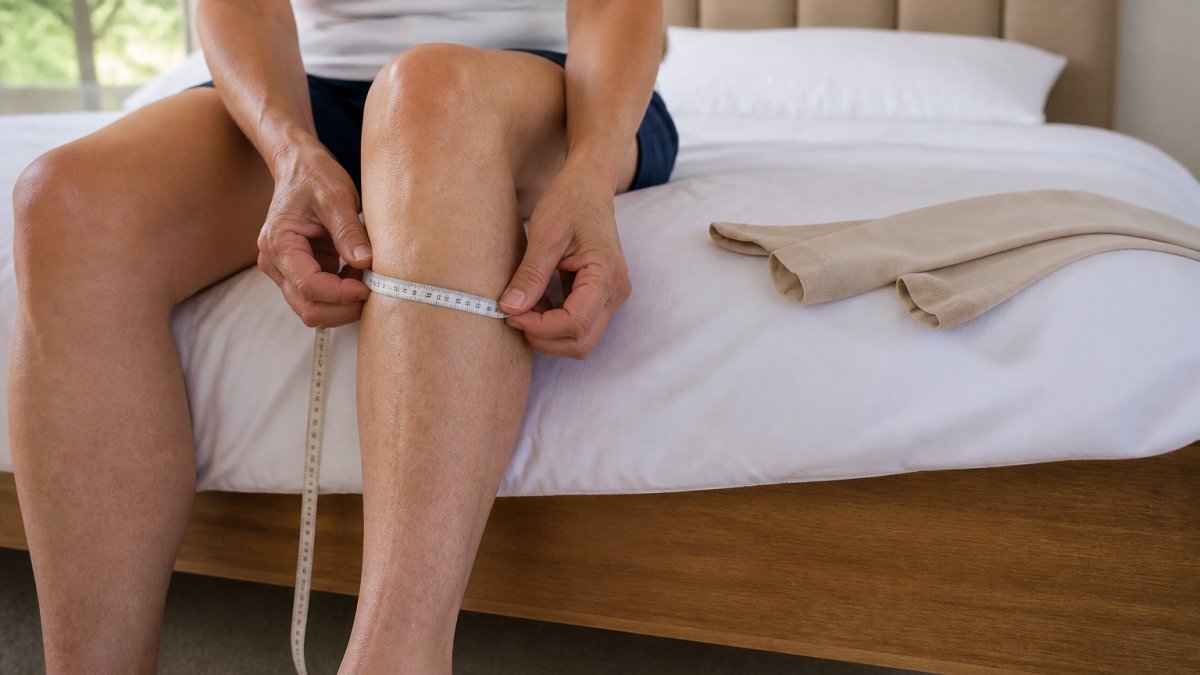
Follow this routine:
- Measure in the morning, before swelling builds.
- Check ankle and calf circumference against the brand's size chart.
- Measure leg length if the sock is knee-high.
- Put the sock on first thing, before you get out of bed if possible.
- Smooth out wrinkles so pressure stays even.
- Check for pinching or rolling at the top band.
- Wash gently and air dry to protect the elastic.
- Replace the pair when it loses its snap, usually over months of regular wear.
Watch out: guessing your size is the most common mistake. Measure, then measure again.
Supporting Circulation From the Inside
External pressure is one lever for circulation. The other is internal: your body's own nitric oxide signaling, which helps blood vessels relax and widen.
Our formula pairs L-Arginine and L-Citrulline with antioxidant-rich Australian botanicals, including Kakadu Plum and Davidson's Plum, in a lemon-yellow drink you mix into water. It is not a pill.
For best results, we suggest taking it twice daily, 12 hours apart, to keep nitric oxide production steady.
You can shop ėNOS and see the full formula. And before adding any supplement, talk with your doctor about how it fits your care.
Frequently Asked Questions
How long does it take compression socks to improve circulation?
Many people notice less leg heaviness or swelling within a few hours of putting them on, because the pressure starts assisting venous return right away. Effects on longer-term vascular health depend on consistent use and on the underlying reason you are wearing them. Compression is a support measure, not a treatment for a diagnosed circulation condition, so give it a few weeks of regular wear and judge by whether swelling, aching, or end-of-day heaviness actually ease.
How many hours a day should someone wear compression socks?
Most people do well wearing them during the hours they are upright and most active, then removing them for sleep unless a clinician has told them otherwise. Put them on in the morning before swelling builds, since they are harder to apply over an already swollen leg. If you sit or stand for long stretches, wearing them through the workday is the common approach. Anyone with a diagnosed vascular condition should follow the schedule their healthcare professional sets.
Who should avoid wearing compression socks?
Compression socks are not appropriate for everyone. People with significant peripheral arterial disease, poorly controlled heart failure, or certain skin infections on the leg should not use them without medical clearance, because pressure that is fine for healthy veins can be a problem when arterial blood flow is already reduced. A clinician can screen arterial circulation before you start. If you develop numbness, tingling, discoloration, or increasing pain while wearing them, remove them and seek advice.
Do compression socks help prevent blood clots?
Graduated compression is used in healthcare settings to support venous return in people who are immobile, such as during hospital stays or long travel, and reduced pooling is part of why it is used there. That is not the same as saying a pair of socks prevents deep vein thrombosis for everyone. Clot risk depends on many factors, and anyone with a personal or family history of DVT should talk to a healthcare professional rather than relying on compression alone.
Compression socks support circulation from the outside; healthy nitric oxide production supports it from within. If you want to pair smart daily habits with internal support, ėNOS offers a doctor-designed formula built around L-Arginine, L-Citrulline, and rare Australian superfruits. Get started with ėNOS and support your heart and circulation from the inside out.