 Listicle
Best Yoga Poses for Blood Circulation: 7 Poses That Work
Table of Contents
- Why Yoga Poses for Blood Circulation Work
- 1. Legs-Up-the-Wall Pose (Viparita Karani)
- 2. Standing Forward Bend (Uttanasana)
- 3. Bridge Pose (Setu Bandhasana)
- 4. Sun Salutations (Surya Namaskar)
- 5. Warrior Poses (Virabhadrasana I and II)
- Yoga for Heart Health: Beyond the Poses
- Benefits of Nitric Oxide for Circulation: eNOS and ėNOS Explained
- Daily Habits for Healthy Blood Circulation
- Sequencing Yoga Poses for Blood Circulation: A 20-Minute Routine
- When to Talk to a Doctor
- Frequently Asked Questions
Last Updated: September 27, 2026
Why Yoga Poses for Blood Circulation Work
Yoga poses for blood circulation work because they combine muscle contraction, gravity, and breath to push blood back toward the heart. This guide from ėNOS explains the physiology, then gives you a 20-minute routine.
Your veins have no pump. Blood returning from your legs depends on surrounding muscles squeezing plus one-way valves that stop it sliding backward, a system called venous return.
Each muscle contraction compresses the deep veins and nudges blood upward; each relaxation lets the vein refill from below. Inversions add gravity, letting blood drain passively from the legs.
How Muscle Contraction and Venous Return Move Blood
Venous return is the volume of blood flowing back to the heart through the veins, driven mainly by skeletal muscle contraction and one-way venous valves. Roughly 60 to 70 percent of your blood volume sits in the venous system at any moment.
Three mechanisms do the work:
- The skeletal muscle pump. Contracting calf and thigh muscles squeeze veins, pushing blood toward the heart.
- The respiratory pump. Deep diaphragmatic breathing changes pressure inside your chest, pulling blood upward.
- Theveno-valvular system. Valves inside your veins open in one direction only.
Yoga hits all three at once, which is why a forward bend or bridge pose feels different from a walk.
Cleveland Clinic overview of the circulatory system
1. Legs-Up-the-Wall Pose (Viparita Karani)
Legs-Up-the-Wall is the most direct inversion for circulation because it removes gravity's pull from your lower body. Lie on your back, slide your hips close to a wall, and rest your legs vertically up it for 5 to 15 minutes.
Blood in your legs no longer fights gravity, so venous return becomes almost passive. Many instructors use it as a restorative finish rather than a warm-up.
A common mistake is placing the hips too far from the wall, which turns it into a hamstring stretch instead of a true inversion. Move closer than feels natural.
2. Standing Forward Bend (Uttanasana)
Standing Forward Bend uses gravity and a gentle hamstring stretch to move blood toward the head and upper body. Stand with feet hip-width apart, hinge at the hips, and let your torso hang with knees as bent as you need.
This is an inversion in disguise: your heart sits above your head, so arterial pressure to the brain rises slightly while venous blood drains from the legs into the torso. It also stretches the entire back line. Hold for 30 to 60 seconds, and come up slowly if you feel lightheaded.
3. Bridge Pose (Setu Bandhasana)
Bridge Pose is the best pose for pelvic and lower-back circulation because it lifts the hips above the heart while engaging the glutes and thighs. Lie on your back, bend your knees, plant your feet hip-width apart, and press your hips toward the ceiling.
The muscle engagement is the point: your glutes and hamstrings contract, squeezing the veins in your pelvic region and driving blood back toward the heart. Hold for 30 seconds to 1 minute, then lower one vertebra at a time. People with neck issues should keep the cervical spine neutral.
4. Sun Salutations (Surya Namaskar)
Sun Salutations are the most efficient circulation sequence in yoga because they move you through forward folds, backbends, and inversions in one continuous flow. One round takes about 60 seconds; five rounds raise your heart rate noticeably.
Rhythm matters more than precision: each breath coordinates with a movement, so the respiratory and muscle pumps fire together, making Sun Salutations feel like light cardio.
Start with three rounds if you are new. Build to eight or ten as your stamina improves.
5. Warrior Poses (Virabhadrasana I and II)
Warrior poses are the standing test of the skeletal muscle pump. In Warrior I (Virabhadrasana I) you lunge forward with the back foot angled about 45 degrees and arms overhead; in Warrior II (Virabhadrasana II) the hips open and the arms extend parallel to the floor. Both ask the quadriceps, hamstrings, and glutes to hold a sustained isometric contraction that keeps venous blood moving out of the legs.
When you hold a lunge, the deep veins in the thigh and calf are compressed against the muscle behind them, pushing blood through the one-way valves toward the heart; when you release, the vein refills from below. Repeat that cycle for 45 seconds and you have effectively run a second heart in each leg.
Balancing on one bent leg also recruits the small stabilizer muscles around the ankle and knee, which participate in venous return.
Alignment cues that matter for circulation specifically:
- Front knee stacked over the ankle, not past the toes. A collapsed knee shortens the quadriceps and reduces the depth of the muscle squeeze.
- Back foot grounded through the outer edge. A lifted back heel turns the pose into a balance drill and removes the calf pump from the equation.
- Hips square in Warrior I, open in Warrior II. Twisting the pelvis in Warrior I reduces the glute contraction that drives pelvic venous return.
- Breathe into the belly, not the chest. A shallow chest breath limits diaphragm descent, which weakens the respiratory pump that works alongside the leg muscles.
Hold each side for 45 to 60 seconds. If your back arches in Warrior I, shorten your stance; if your front knee complains, raise the back heel slightly or reduce the lunge depth.
Most people rush through Warrior poses as strength work. For circulation the opposite is true: the longer you hold a clean, well-aligned lunge, the more complete the venous return cycle.
Yoga for Heart Health: Beyond the Poses
Yoga for heart health goes past the postures: breath work, stress reduction, and consistency all influence cardiovascular function. A single session helps for an hour; a regular practice changes how your blood vessels behave over months.
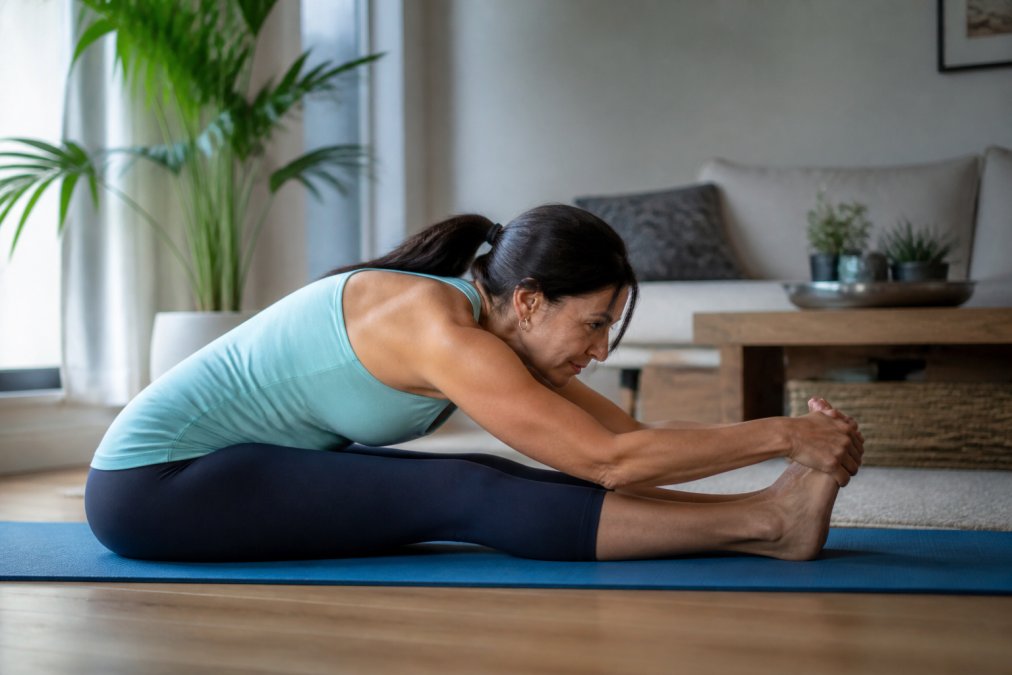
Research from Harvard Health Publishing on yoga and heart health notes that yoga can support blood pressure regulation and vascular health when practiced regularly alongside standard care.
Breathwork (Pranayama) Integration
Diaphragmatic breathing is the most underrated tool here. When you breathe deeply into your belly, your diaphragm descends and creates pressure changes in your chest that pull venous blood toward the heart.
Try this pattern during any pose:
- Inhale through the nose for a count of four, expanding the belly first.
- Hold gently for a count of two.
- Exhale through the nose for a count of six, letting the belly fall.
- Repeat for five cycles before moving to the next pose.
Benefits of Nitric Oxide for Circulation: eNOS and ėNOS Explained
The benefits of nitric oxide for circulation come down to one job: nitric oxide tells your blood vessels to relax and widen. That widening, called vasodilation, lowers resistance and lets blood move more freely.
Daily Habits for Healthy Blood Circulation
Poses help for an hour; habits help around the clock. Here is the list, mapped to the venous-return mechanism each habit supports.
Sequencing Yoga Poses for Blood Circulation: A 20-Minute Routine
| Step | Pose | Duration | Purpose |
|---|---|---|---|
| 1 | Sun Salutations | 5 minutes | Raise heart rate, warm muscles |
| 2 | Warrior I and II | 3 minutes each side | Build heat in the legs |
| 3 | Standing Forward Bend | 1 minute | Gentle inversion, hamstring stretch |
| 4 | Bridge Pose | 1 minute, repeat twice | Pelvic and lower back circulation |
| 5 | Legs-Up-the-Wall | 5 minutes | Passive venous return |
| 6 | Diaphragmatic breathing | 3 minutes | Activate the respiratory pump |
American Heart Association guidance on physical activity and blood pressure
When to Talk to a Doctor
Yoga is a supportive practice, not a treatment. If you take blood pressure medication or manage a cardiovascular condition, talk to your doctor before adding inversions or a new supplement to your routine, and bring the product label so the conversation is specific.
Frequently Asked Questions
What is the best exercise to improve blood circulation?
Any movement that contracts large muscle groups helps circulation, including walking, cycling, and swimming. Yoga poses for blood circulation work because they combine muscle contraction, inversion, and slow breathing. Legs-Up-the-Wall and Standing Forward Bend use gravity to assist venous return, while Sun Salutations keep the heart rate elevated. A mix of aerobic activity and yoga gives you the best of both: cardiac conditioning plus flexibility, stress reduction, and lymphatic drainage support.
How does yoga impact the body's natural nitric oxide production?
Slow, diaphragmatic breathing and steady movement support the endothelium, the lining of your blood vessels, which produces nitric oxide through the enzyme eNOS (endothelial nitric oxide synthase). Nitric oxide signals vessels to relax and widen, supporting healthy arterial pressure and blood flow. Note that eNOS is the body's own enzyme; ėNOS is a separate branded supplement name, not the same thing. Poses like Bridge and Warrior poses, combined with calm breathing, create conditions that support this natural process.
Can daily yoga practice support long-term cardiovascular health?
Regular practice supports cardiovascular health through several pathways: it lowers resting heart rate, supports blood pressure regulation, improves flexibility and mobility, and reduces stress. Yoga for heart health works best as part of a broader routine that includes aerobic exercise, balanced nutrition, and adequate sleep. Consistency matters more than intensity. Even 15 to 20 minutes daily of poses like Sun Salutations and Legs-Up-the-Wall can contribute to vascular health over time.
How do inversions and twists help with circulation?
Inversions like Legs-Up-the-Wall reverse the usual gravitational pull on your legs, helping blood return to the heart more easily. Twists compress and then release the torso, which changes pressure inside the abdomen and chest, encouraging fresh blood flow when you unwind. Together they support venous return, lymphatic drainage, and oxygenation of tissues. If you have uncontrolled high blood pressure or glaucoma, check with your doctor before practicing inversions.